

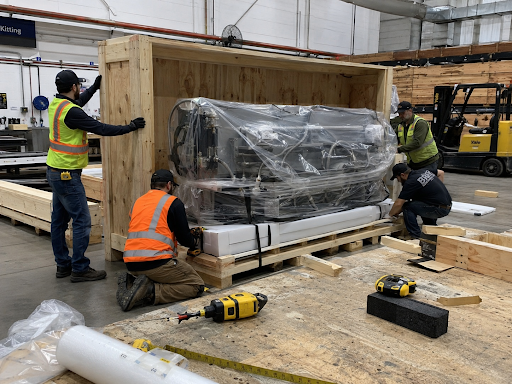
Machinery should be prepared for shipping by confirming its final dimensions and weight, following the manufacturer’s shutdown instructions, securing movable parts, protecting sensitive surfaces, and mounting the equipment to a properly designed skid or crate. Learning how to prepare machinery for shipping also means planning for lifting, loading, documentation, moisture exposure, and unloading before the carrier arrives.
Every detail matters. One inaccurate measurement can affect trailer selection. One unsecured component can damage an otherwise sound machine. And one missing export mark can hold up an international shipment.
What Information Should Be Verified Before Packing Starts?
Start with the machine’s actual specifications and shipping configuration. Record its make, model, serial number, replacement value, operating condition, weight, and dimensions. Use the manufacturer’s documentation or data plate whenever possible rather than relying on estimates.
Measure the equipment as it will be shipped—not as it sits on the production floor. Include skids, brackets, guards, attachments, protective materials, and any components that will remain installed.
You should also identify:
- The center of gravity
- Approved lifting points
- Tie-down locations
- Fragile or restricted-contact areas
- Forklift, crane, and rigging requirements
- Doorway, aisle, dock, and floor-loading limitations
Confirm whether the machine will travel by enclosed trailer, flatbed, ocean container, flat rack, or another method. The shipping mode affects exposure, handling frequency, packaging design, permits, and securement requirements.
How Should Machinery Be Cleaned and Shut Down Safely?
Clean the machine thoroughly before disconnecting or packing it. Remove dirt, metal chips, processing residue, grease buildup, standing coolant, and other contaminants. A clean surface makes leaks, cracks, loose fasteners, and pre-existing damage easier to identify.
Follow the manufacturer’s shutdown instructions when isolating electrical, hydraulic, pneumatic, water, gas, or mechanical energy. Where preparation involves servicing or maintenance, trained personnel should follow the facility’s applicable energy-control procedures. OSHA explains that proper lockout/tagout practices protect workers from unexpected startup or the release of stored energy. (OSHA)
Drain or reduce fuel, coolant, oil, and other fluids only as required by the equipment manufacturer, carrier, or destination. Some reservoirs must remain sealed or lubricated. Cap disconnected hoses, seal open ports, protect battery terminals, and make sure residual fluid cannot reach wiring or controls.
Which Parts Must Be Removed, Locked, or Packed Separately?
Anything that can swing, slide, rotate, vibrate, or detach during transport must be removed or mechanically secured.
Place arms, booms, tables, doors, turrets, spindles, guards, and other moving assemblies in their manufacturer-approved transport positions. Use suitable shipping brackets, mechanical locks, blocking, or banding. Tape and stretch wrap may contain light materials, but they are not structural securement.
Remove vulnerable accessories when practical. Tooling, monitors, control pendants, sensors, probes, hoses, cables, fixtures, keys, and specialized hardware should be labeled and entered on an inventory.
Pack each component according to its fragility. Clear identification now can prevent confusion, missing parts, and unnecessary downtime during reassembly.
How Can Corrosion, Moisture, Shock, and Vibration Be Controlled?
Protection should match the machine’s sensitivity, transit duration, climate exposure, storage conditions, and number of handling points.
Bare metal and precision surfaces may need a compatible corrosion inhibitor. Electrical cabinets, bearings, control systems, sensors, and machined components may require barrier film, vapor corrosion inhibitor materials, desiccants, or sealed protection.
For more demanding shipments, industrial preservation packaging can combine vacuum sealing, moisture barriers, corrosion protection, cushioning, and custom dunnage. Express Packing offers options including VCI materials, non-abrasive foams, desiccants, and protection for sensitive industrial machinery.
Cushioning should reduce shock and vibration without pressing against switches, shafts, unsupported panels, or delicate surfaces. The machine must also be completely dry before it is enclosed. Sealing moisture inside a crate can create the very corrosion problem the packaging was meant to prevent.
What Kind of Skid, Crate, Blocking, and Bracing Does the Machine Require?
The packaging must support the full weight of the machine, distribute concentrated loads, provide safe handling access, and prevent movement in every direction.
Possible formats include a custom skid, open slat crate, fully enclosed crate, reusable crate, or containerized blocking-and-bracing system. The correct option depends on the machine’s weight, shape, fragility, exposure, value, destination, and transportation method.
Professional custom wood crate packing begins with the equipment’s actual dimensions, weight, fragility, and special handling requirements. A custom design can incorporate reinforced bases, forklift access, lifting provisions, cushioning, and removable panels for easier unpacking.
The machine may be bolted or banded to its skid, then structurally blocked around the base. Bracing should resist forward, rearward, lateral, and vertical movement without transferring damaging pressure to the equipment.
Federal motor-carrier requirements specify performance criteria for securement systems used to prevent cargo movement under forces created during acceleration, braking, and turning. (Electronic Code of Federal Regulations)
For equipment that cannot fit standard arrangements, oversize and overweight container packing may involve custom-engineered skids, reinforced bracing, and load-distribution planning.
Which Labels and Documents Help Prevent Shipping Delays?
The machinery, loose components, packaging, and shipping documents should contain matching information.
Prepare a packing list, component inventory, condition report, equipment serial number, packed dimensions, gross weight, destination details, receiving contact, and unpacking instructions. Photograph the machine before packing and photograph the completed crate from every side.
External markings should clearly identify orientation, lift points, sling locations, center of gravity, handling restrictions, and any areas where forklift contact is prohibited.
International shipments using regulated wood packaging may require heat-treated export packing. USDA APHIS states that regulated wood packaging must be treated and certified under ISPM 15 when required by the importing country. (USDA APHIS)
The compliant certifying wood packing mark should be permanent, visible, and applied correctly to the certified packaging.
What Must Be Confirmed Before the Carrier Arrives?
Compare the final packed dimensions and weight with the carrier’s booking information. Recheck bolts, bands, seals, blocks, braces, crate panels, labels, and loose-component inventories.
Then confirm the loading plan:
- Is the exit path clear?
- Are the correct forklift, crane, and rigging resources available?
- Can the loading surface support the combined weight?
- Does the carrier have the lifting and handling instructions?
- Can the receiving site unload the shipment safely?
Send the final dimensions, weight, photographs, and unloading requirements to the destination contact. For stationary, oversized, or highly sensitive equipment, on-site machinery packing can reduce unnecessary moves by packing the machine at its current location.
What Else Should Shippers Know Before Machinery Pickup?
How far in advance should machinery preparation begin?
Begin as early as practical. Complex projects may require custom crate fabrication, disassembly, rigging, export documentation, permits, site coordination, or carrier approval. Involving the packing provider before transportation is booked helps prevent mismatched equipment and rushed decisions.
Does every machine need a fully enclosed crate?
No. Some durable machinery can travel safely on an engineered skid or in an open crate. Sensitive, high-value, export-bound, weather-exposed, or calibration-dependent equipment may need a fully enclosed or sealed system.
Should all machinery fluids be completely drained?
Not automatically. Requirements differ by machine, carrier, and transportation mode. Follow the manufacturer’s instructions and disclose remaining fluids to the carrier or packing provider.
What information is needed for a machinery-packing quote?
Provide the machine type, dimensions, weight, photographs, pickup site, destination, shipping method, target date, exposure conditions, available handling equipment, and any special corrosion or shock-protection requirements.
Who should prepare highly sensitive or oversized machinery?
Professional support is advisable when equipment is unusually heavy, difficult to access, high-value, calibrated, export-bound, or beyond the facility’s in-house lifting and packing capabilities.
Why Does the Final Check Matter?
Most preventable shipping problems begin before the truck arrives. An inaccurate measurement, unsecured assembly, weak base, missing label, or unplanned exit path can cause damage and lost time.
Review the machine, crate, securement, paperwork, loading process, and destination requirements as one connected system. Not separate tasks. One shipment plan.
Why Express Packing Is Your Ideal Choice for Machinery Shipping Preparation?
Express Packing designs and builds custom crates, skids, blocking, bracing, cushioning, and preservation systems around the actual equipment and shipping environment. Serving industrial customers since 1987, the company supports heavy machinery, oversized equipment, sensitive components, domestic transportation, and international export projects. Each solution considers the machine’s weight, shape, fragility, handling points, route, and exposure.
The team can also pack machinery at the customer’s facility, coordinate heat-treated wood packaging, and incorporate corrosion-control materials or reinforced container bracing. Its industrial packaging case studies demonstrate how an engineering-focused approach can reduce handling risks, improve load stability, and solve difficult packing challenges.
Ready to Prepare Your Machinery for Shipment With Express Packing?
Share your machine’s dimensions, weight, photographs, pickup location, destination, shipping method, timeline, and special handling needs. Request a custom machinery-packing quote from Express Packing and build a safer, more predictable shipment from the start.