To understand how to measure equipment for a shipping crate, first place the machine in its final shipping position and record its maximum overall length, width, and height. Include every fixed protrusion, then document removable parts, weight, lifting points, support locations, and handling restrictions.
Measure the equipment itself—not the crate you think it needs. A professional crating provider will use your measurements to calculate space for the skid, blocking, bracing, cushioning, moisture barriers, and crate structure. That separation prevents oversized crates, poor fits, and costly fabrication changes.
What Should You Prepare Before Measuring Industrial Equipment?
Prepare the machine in the same configuration in which it will travel. Fold adjustable components, lock movable assemblies, secure doors, and determine whether guards, hoses, control panels, or accessories will remain attached. When components will be removed, label and measure them separately.
Use a steel tape measure, straightedge, level, marker, camera, and simple measurement sheet. You also need a verified equipment weight from a scale, manufacturer drawing, nameplate, or other dependable record. Never estimate the weight of heavy machinery from appearance alone.
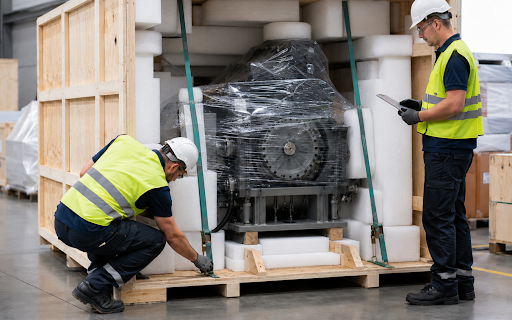
Large, stationary, calibrated, or difficult-to-access assets may require professional on-site packing services. An on-site assessment allows the crating team to evaluate dimensions, access limitations, lifting equipment, floor conditions, and the safest packing sequence before construction begins.
How Do You Capture the Equipment’s True Overall Dimensions?
Measure the smallest imaginary rectangular box that would completely contain the equipment in its shipping position. This is sometimes called its maximum envelope.
Follow this sequence:
- Measure the longest end-to-end distance and record it as the length.
- Measure the widest side-to-side distance and record it as the width.
- Measure from the lowest support point to the highest fixed point and record it as the height.
- Repeat every measurement from another position.
- Record all dimensions consistently as L × W × H, using either inches or millimeters.
Measure between the outermost points—not merely across the main cabinet, frame, or housing. A machine body may be 72 inches long while a fixed handle extends its actual shipping length to 78 inches. The crate must accommodate 78 inches.
Keep the tape straight and parallel to the corresponding axis. For irregular equipment, a level or straightedge can help project the furthest point down to the floor so the measurement is not distorted by an angle.
How Should You Measure Protrusions and Irregular Components?
Include every fixed component that extends beyond the main body. Commonly missed points include valves, handles, motors, guards, feet, wheels, exhausts, brackets, connectors, control panels, and lifting eyes.
Flexible hoses and cables may be secured within the equipment’s main envelope, but confirm that doing so will not create an unsafe bend or damage a connection. Components removed for transport should be listed separately with their own dimensions and weight. Note whether they will be packed in the same crate, attached to the skid, or placed in an internal compartment.
Photograph irregular areas from several angles. Mark removable items with numbers that correspond to the measurement sheet. Simple documentation now. Fewer questions during fabrication.
How Much Clearance Should Be Added for Protection?
Do not add an arbitrary two, four, or six inches to every side. Report the equipment’s exact maximum dimensions and allow the crate designer to determine the required clearance.
Three measurements must remain distinct:
- Equipment dimensions describe the machine’s actual maximum envelope.
- Internal crate dimensions include space for blocking, bracing, cushioning, wrapping, barriers, and installation access.
- External crate dimensions include the walls, framing, base, and skids.
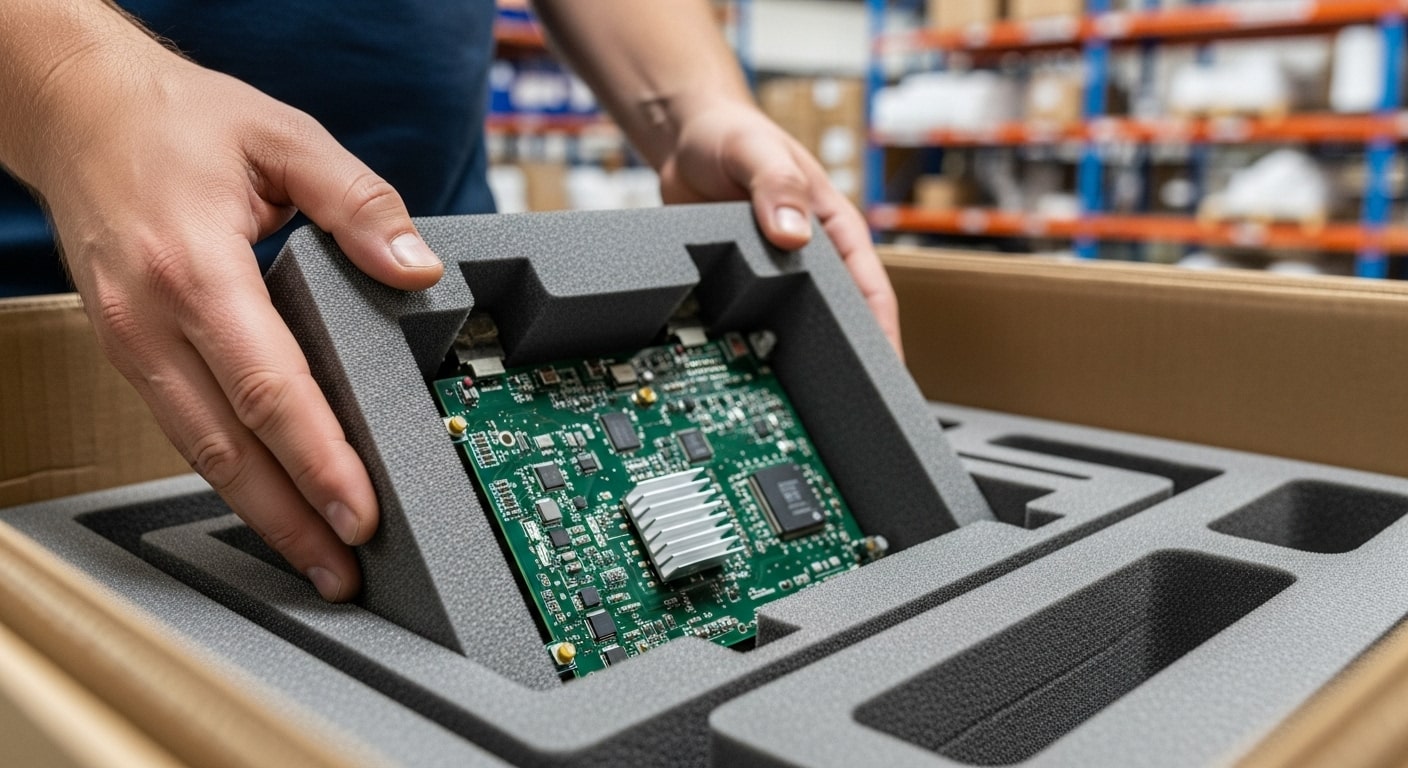
The necessary space depends on equipment weight, fragility, shock sensitivity, surface finishes, preservation requirements, and transportation mode. A rugged steel assembly may require firm blocking with limited clearance. A sensitive instrument could need engineered cushioning that isolates it from shock and vibration.
Freight can encounter forklifts, repeated transfers, stacking forces, vibration, and multiple transportation vehicles. Protection must therefore be designed around the hazards of the route, not simply the equipment’s size.
For moisture-sensitive machinery, industrial preservation packaging services may incorporate barrier materials, corrosion protection, desiccants, cushioning, or other protective methods that influence the required internal space.
Not Sure Your Measurements Capture Every Protrusion?
One missed valve, control arm, or lifting point can delay fabrication. Express Packing provides on-site packing and equipment assessments to help verify dimensions, handling requirements, and access conditions before the crate is built.
Schedule an On-Site Equipment Review.
What Information Does the Crate Designer Need Besides Dimensions?
Length, width, and height define the envelope. They do not determine whether the finished load can be safely supported or handled.
Provide the following:
- Verified equipment weight
- Approximate center of gravity
- Concentrated or uneven point loads
- Mounting feet and bolt-hole locations
- Approved blocking and support areas
- Areas that must not be contacted
- Existing forklift pockets
- Required fork-entry direction
- Crane lifting points
- Upright-only restrictions
- Stackability limitations
- Fragile or shock-sensitive components
- Domestic, air, ocean, or multimodal shipping plans
Weight distribution matters because forklift capacity depends on both load weight and the distance between the load’s center of gravity and the fork face. OSHA notes that irregular shape, position, and uneven distribution can reduce effective lifting capacity and affect stability.
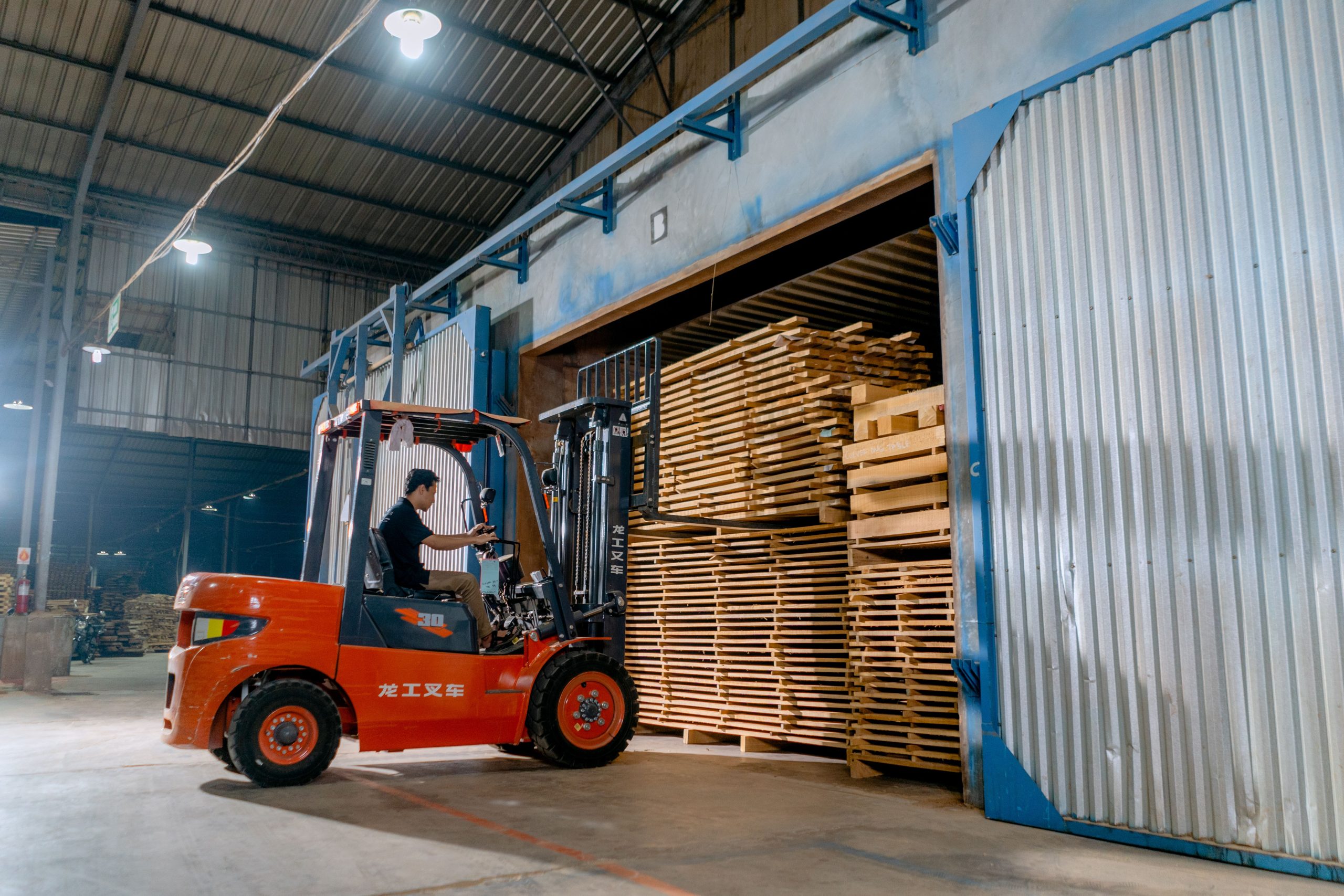
For exceptionally large or heavy machinery, the crate design may also need to account for container loading, access clearances, rigging, and load securement. Express Packing provides oversize and overweight container packing for cargo that requires more than standard handling.
How Can You Verify the Measurements Before Ordering a Crate?
Repeat all three maximum measurements and ask a second person to check them independently. Confirm that the machine is still in its intended shipping orientation and that no temporary cover, fitting, caster, or attachment has been overlooked.
Take photographs of the front, rear, sides, top, and base. Include a tape measure in selected images for scale, but do not rely on photos as a substitute for written dimensions. Add a basic sketch showing the major measurements, protrusions, mounting points, and shipping orientation.
Mark every dimension as exact, estimated, or taken from an OEM drawing. When manufacturer drawings are available, send them with the field measurements and note any modifications that may have changed the original configuration.
Examples of how handling, blocking, and workflow can affect packaging performance are available in Express Packing’s industrial packaging and custom-crating case studies.
Which Measuring Mistakes Cause Poor-Fitting Crates?
The most common mistake is measuring the machine’s main body instead of its complete shipping envelope. Other frequent problems include measuring in the operating position, rounding down, mixing inches and millimeters, and overlooking feet, valves, handles, guards, or connectors.
Another costly error is treating the equipment dimensions as the final crate dimensions. The base, blocking, cushioning, framing, and wall materials all add size. Guessing that allowance can produce a crate that is either too tight to pack correctly or unnecessarily large.
One missed control arm. One unusable crate.
Unverified weight is equally risky. A dimensional fit does not guarantee that the base, lifting points, or handling equipment can support the load.
What Should You Send With a Custom Crating Quote Request?
Send a complete measurement package rather than three unsupported numbers. It should include maximum dimensions, verified weight, photographs, a dimensioned sketch, removable-parts information, support points, lifting requirements, destination, transportation mode, and the required completion date.
State whether the shipment is domestic or international. Wood packaging used in international trade may need to meet ISPM 15 phytosanitary requirements, which are intended to reduce the spread of pests associated with raw wood packaging material. Express Packing offers heat-treated packing services for export shipments requiring compliant wood packaging.
Frequently Asked Questions
Should equipment be measured assembled or disassembled?
Measure it in the configuration in which it will actually ship. Document removed components separately and state whether they will travel inside the same crate.
Should equipment dimensions be rounded up?
Record the most precise dependable measurement available. Never round down. The crating provider should apply the fabrication and protective allowances.
Is crate clearance the same for every machine?
No. Clearance depends on weight, fragility, cushioning, blocking, moisture protection, transportation mode, and the amount of access needed during packing.
Can photographs replace exact measurements?
No. Photographs reveal shape, condition, and access constraints, but they do not provide dependable scale or expose every hidden projection.
When should a professional measure the equipment on-site?
Consider an on-site assessment for oversized, immovable, calibrated, unusually shaped, high-value, or difficult-to-access machinery.
Does international shipping change the measurement process?
The basic dimensional process stays the same. However, the crate provider also needs the destination, transportation route, preservation requirements, handling restrictions, and export-compliance information.
Check the Complete Measurement Package Before Fabrication
Accurate dimensions are the starting point—not the full crate specification. Verify the shipping orientation, protrusions, weight, support locations, and handling requirements before submitting the project.
Clear numbers. Useful photographs. No assumptions. Give the crating team enough information to engineer the protection instead of compensating for missing details during fabrication.
Why Express Packing Is Your Ideal Choice for Industrial Crating
Express Packing builds made-to-order custom wood packing and crate solutions for industrial, oversized, sensitive, and export cargo. Its team evaluates the equipment’s dimensions, weight distribution, support requirements, transportation route, and exposure risks before determining the crate configuration. Blocking, bracing, skids, cushioning, and preservation materials are selected around the actual asset—not a standard box size.
The company can also bring its equipment and expertise directly to a customer’s facility when moving the machinery before packing would create unnecessary risk. Capabilities include on-site crating, preservation protection, oversized-load support, and heat-treated export packaging. That integrated approach helps manufacturers reduce handling steps, avoid preventable fit problems, and prepare complex equipment for domestic or international transit.
Send Express Packing Your Equipment Specifications
Send Express Packing your equipment dimensions, verified weight, photographs, destination, and handling requirements. The team can review the shipment, identify missing information, and recommend an appropriate crate and protection system.
Request a custom-crating quote from Express Packing before estimating clearance or construction requirements on your own.